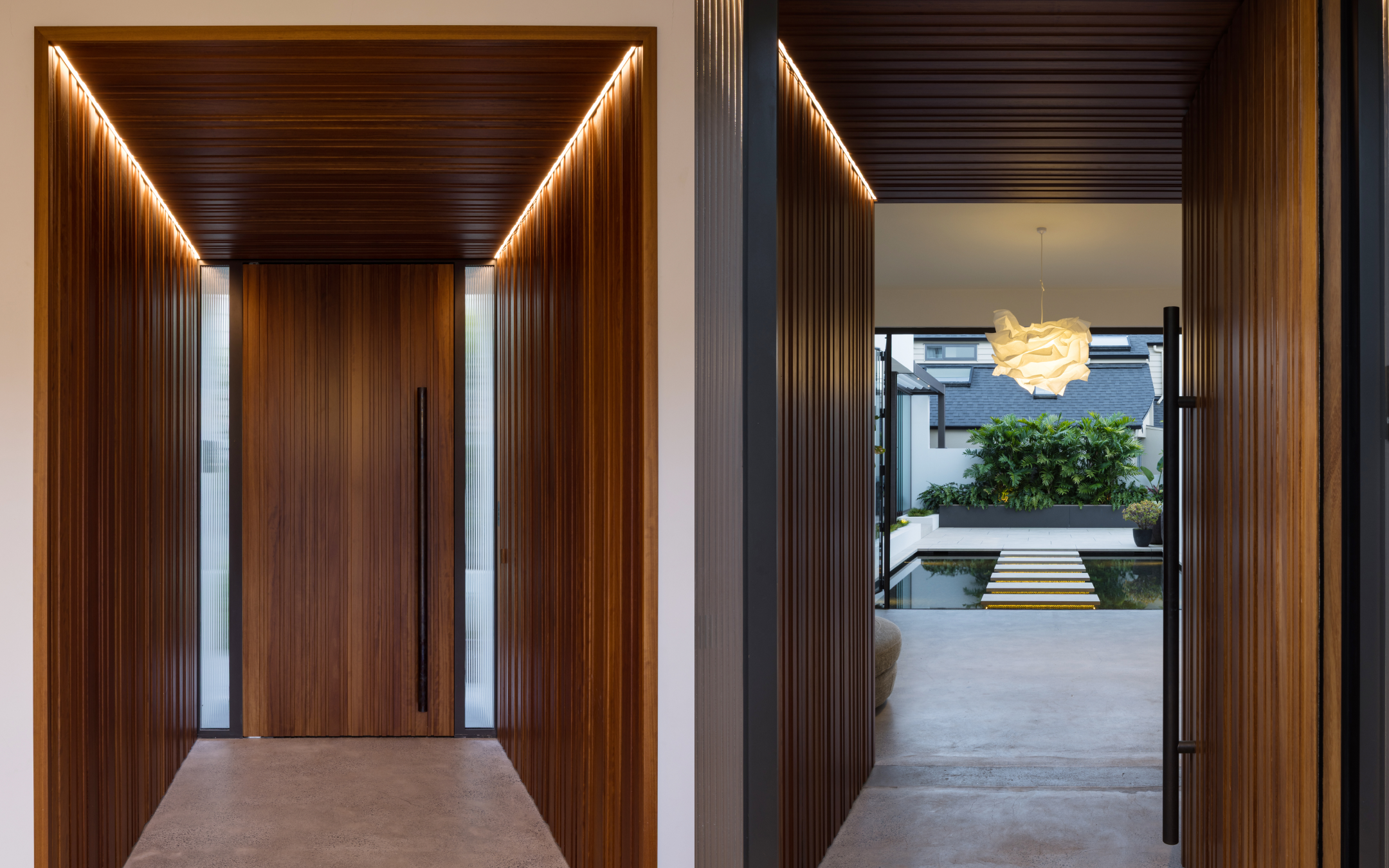
This project started with a client, a designer himself, coming to us with a clear vision: to create an entryway using an exotic timber that would cultivate a unique experience. The intent was for the entry to read as one continuous element. The same timber wraps from the door across the surrounding wall lining, creating a cohesive surface rather than a traditional break between materials. Even the door itself is concealed within that lining, sitting flush so nothing interrupts the form. While from a design point of view, it’s restrained, from a construction point of view, it’s technical and takes a lot more work than it lets on. So let’s break it down.
Achieving that level of continuity meant careful coordination early on, and a clear vision from the client/designer. The door, cladding, and steel joinery all needed to align precisely, with tolerances tight enough to maintain the clean lines without compromising function.
We worked closely with specialist joiners to fabricate the custom timber elements, ensuring everything fit within the constraints of the surrounding structure. With the steel window joinery sitting alongside the timber, there was little room for error. Every junction needed to be resolved before anything hit site.
The hidden door added another layer again. It needed to operate like a standard door, but visually disappear into the wall, so there was absolutely no room for error with the pre-install work.
The selected timber, Iroko, played a big role in the final outcome. Often referred to as “African Teak”, it’s a durable West African hardwood suited to exterior use, with strong resistance to weathering, rot, and insects. When freshly machined, it presents as a light yellow tone, but that wasn’t the brief here.
To achieve the deeper, richer finish, the timber was left to naturally weather in the sun before any coating was applied. That step was critical. The coating system includes UV protection, which locks in the colour at the point of application. Applying it too early would have meant holding onto that lighter, unfinished look. Instead, we waited until the timber reached the exact tone the client was after, then applied the coating to seal and preserve it.
Projects like this don’t come together without the right people involved. The custom timber fabrication was delivered by Next Level Joinery. Steel windows and doors were supplied and installed by Crittall. Wood Star Joinery supported the timber coating process, while the door hardware was built around a FritsJurgens pivot system and finished with a custom brass handle. Integrated LED lighting by Tindalls Electrical completed the space. Each trade played a specific role, and getting the sequencing right was just as important as the work itself. Thankfully, every one of our partners nailed it, and the final result was as seamless as the design.
What reads as a simple entrance is the result of a lot of detailed thinking, coordination, and patience, particularly when working with natural materials that don’t always operate on a fixed timeline. And the entryway experience that all of the above elements combined to create made it all worth it, for us and the client, so we won’t be forgetting this project anytime soon.